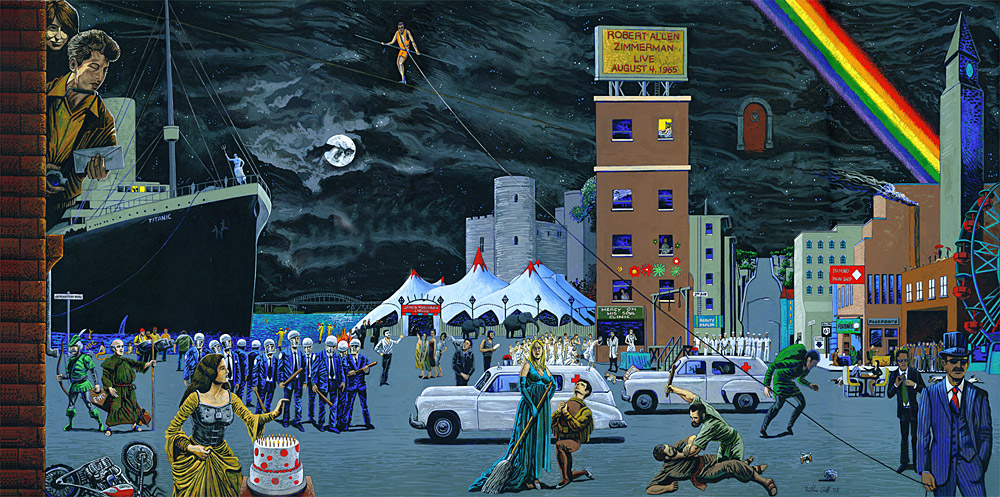
Bob Dylan’s “Desolation Row” was released on the controversial 1965 album, Highway 61 Revisited. The song itself is an eleven minute, ten verse, folk ballad that is lacking a single chorus. It is one of his strange masterpieces. The ballad is a surreal collection of verses: each on a situation between historical and/or fictional characters that all have some relation to the cryptic “Desolation Row.” On a deeper level, the song is about different individuals navigating their own personal struggles and the turmoil of the period the song was released in. The titular “Desolation Row” is an unattainable place of comfort and reason. It is the places that all of the song’s subjects are try to get to.
The first verse sets the tone with surreal yet slightly macabre imagery and allusions. It mentions “they’re selling postcards of the hanging…the circus is in town” (line 1 and 4). Critic, Mark Polzzitti suggested that in his 2000 book, Bob Dylan’s Highway 61 Revisited, that the hanging is reference to the 1920 lynching of three African American men traveling with a circus in Duluth, where Dylan grew up. The lines “And the riot squad they’re restless/ They need somewhere to go” (lines 9 and 10) evokes the societal chaos of the mid 1960s, referencing the militarization of the police in this era. But the pair of lines “As Lady and I look out tonight/ From Desolation Row” (lines 11 and 12) make the case that the narrator is viewing the turmoil in a situation of security and understanding. When Dylan uses the language “Lady and I,” its possible that he is alluding to Lady and the Tramp; saying that as a tramping vagabond, he is removed of the societal turmoil and is in a position to view, understand, and criticize it.
He references the character, Ophelia, from the play, Hamlet. He mentions that “for her I feels so afraid” (line 38) meaning that Dylan is using the character to talk about someone he is worried for and cares about. The lines “her profession is her religion/ her son is her lifelessness” (lines 43 and 44) reference when Hamlet telling Ophelia to leave him and become a nun. This is possibly a metaphor for Dylan pushing this girl out. And the lines “And though her eyes are fixed upon/ Noah’s great rainbow/ She spends her time peeking/ Into Desolation Row” (lines 45-48) suggest that she too is fixated on this “Desolation Row” and the consolation that it brings.
Verse three seems to be about a person who has fallen from grace. The introduction of to the subject of this verse —“Einstein, disguised as Robin Hood/ With his memories in a trunk” (lines 49 and 50) —shows us, the listeners, that the subject was once a intelligent, respectable man but has fallen into shabbiness and irrespectability: Einstein being a intelligent genius, and carrying “his memories in a truck” meaning he is the soul keeper of the memory of his once existing fame and fortune. The line “And he went off sniffing drainpipes and reciting the alphabet” (lines 55 and 56) proposes that this man sniffs the glue used to seal drain pipes for a high while reciting to alphabet to show how clever he is. The lines “You would not think to look at him, but he was famous long ago/ For playing the electric violin on Desolation Row“ (line 59 and 60) solidify the understanding that he once existed in the state of reason (Desolation Row), but now that time only exists in his memories.
This dynamics that play out in the song reflect upon the idea that Desolation Row is representative of a state of reason and resolve that people lack and are fixated on getting. Ideas like this are the kind of ideas that separate Bob Dylan‘s work apart from other artists.
 Creative Minds